
Reviews of Recent Independent, Foreign, & Documentary Films
in Theaters and DVD/Home Video
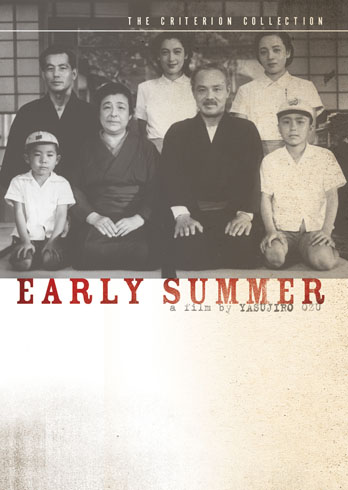
EARLY SUMMER
Directed by: Yasujiro Ozu.
Produced by: Takeshi Yamamoto.
Written by: Kogo Noda & Yasujiro Ozu.
Director of Photography: Yuharu Atsuta.
Edited by: Yoshiyasu Hamamura.
Music by: Senji Ito.
Released by: The Criterion Collection.
Language: Japanese with English subtitles.
Country of Origin: Japan. 125 min. Not Rated.
With: Setsuko Hara, Chishu Ryu, Chikage Awashima, Kuniko Miyake & Ichiro Sagai.
DVD Features: New high-definition digital transfer with restored image & sound. Commentary by Donald Richie, author of
Ozu and A Hundred Years of Japanese Film. "Ozu's Films from Behind the Scenes," a conversation with child-actor
& sound technician Kojiro Suematsu, assistant cameraman Takashi Kawamata & producer
Shizuo Yamanouchi. Trailer. New & improved English translation. Essay by David Bordwell, author
of Ozu and the Poetics of Cinema and an article by filmmaker Jim Jarmusch.
Like many of Yasujiro Ozu's films, Early Summer emphasizes character rather
than plot. Set in post-war Tokyo, it portrays an average Japanese family - the simple life
that Ozu dearly favored.
Noriko (Setsuko Hara), a 28-year-old single working woman is urged by her family to get
married soon. When her brother pressures her, she laughs it off. When a friend boasts of
her marriage, she points out the benefits of being unmarried. Confident and optimistic,
she eludes the pressure and criticism with her smile. But when her boss offers an arranged
marriage to a promising older executive, everyone, except for Noriko, is thrilled. Unable
to refuse on the spot, Noriko leaves her boss's offer up in the air. However, out of the blue, another unexpected prospect is
offered to Noriko, and her sudden change of heart takes everyone aback.
This lengthy and leisurely-paced film develops its characters through layered details. The
characters seem to develop as they go about their daily lives, and so in a sense this film
takes the form of a documentary; plot is just a sidebar. And complex social issues are
interwoven throughout the film - the changing role of women, family bonds, and the
integrity of marriage, topics reminiscent of films of that era, but no less topical today.
DVD Extras: In his commentary, Ozu-savvy Donald Richie, as always, guides
you through the film by filling in the little details that are not always evident.
Interestingly, Richie compares Ozu to Jane Austen, and notes the influence of Ernst
Lubitsch on the film’s cinematography. The informative "Ozu Films Behind the Scenes"
features three older men, all part of Ozu's production team, sitting in modern-day
Kamakura (the location of Early Summer) and discussing Ozu as a director as
well as friend. (He was constantly drinking, says one former producer; it was quite a
job to get him home.)
In respective essays, David Bordwell expresses his belief that Ozu was ahead of his time
in focusing on an ensemble of inner-connected characters, as opposed to a single
protagonist; and director Jim Jarmusch, his surprise that Ozu has fallen out of fashion in
Japan. Fittingly, Jarmusch writes, "Films made by Ozu may drift in and out of fashion,
but their stylistic strengths and particularities are not moveable." Hazuki Aikawa, journalist, director of the documentary Yancha
September 15, 2004
HomeAbout
Film-Forward.com Archive of Previous
Reviews
|