
Reviews of Recent Independent, Foreign, & Documentary Films
in Theaters and DVD/Home Video
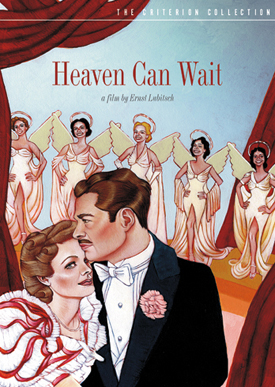
HEAVEN CAN WAIT (1943)
Directed & Produced by: Ernst Lubitsch.
Written by: Samson Raphaelson, based on the play Birthday by Lazlo Bus-Fekete.
Director of Photography: Edward Cronjager.
Edited by: Dorothy Spencer.
Music by: Alfred Newman.
Released by: Criterion.
Country of Origin: USA. 112 min. Not Rated.
With: Don Ameche, Gene Tierney, Charles Coburn, Marjorie Main, Laird Cregar, Spring Byington,
Allyn Joslyn, Eugene Pallette, Signe Hasso & Louis Calhern.
DVD Features: Video conversation between film critics Molly Haskell & Andrew Sarris.
"Creativity with Bill Moyers: A Portrait of Samson Raphaelson" (1982), a 30-minute
program exploring the screenwriter's life & career. Audio seminar with Raphaelson &
film critic Richard Corliss recorded at the Museum of Modern Art in 1977. Lubitsch home piano
recordings. Trailer. A new essay by film scholar William Paul. Restored high-definition
digital transfer.
This 1943 production from director Ernst Lubitsch's long partnership with playwright Samson Raphaelson has
accrued fame for being one of the pair's most enduring collaborations, even though the
"Lubitsch touch" is more subdued here than in the pair's Trouble in Paradise and
Shop Around the Corner, and barely recognizable from the director's silent works. From the opening scene, where Henry Van Cleve (Don Ameche) arrives in
Satan's executive suite in Hell, this is a decidedly restrained picture for the duo.
Besides providing film history with one of its most memorable interpretations of Hell, the
scene sets the bar for the movie: witty dialogue is exchanged for witty circumstances;
the overt Lubitsch opulence, for discrete indicators of social class; biting sexual
humor is given over to a decidedly chaste rendering of pleasure; and homespun Americana,
instead of Continental sophistication.
Even the movie's structure is more drawn out and nuanced than the partners' previous
pictures. Assuming his wandering eye and lies has warranted eternal suffering, Henry
insists to a confused and comically conversational Lucifer he deserves a spot in
Hell. He relays his life's story and all its damning events, which provides a fairly original
narrative framework. Of course, in each segment he, instead, displays a good-natured
and earnest quality that shows why he belongs in Heaven, providing Lubitsch and
Raphaelson with a platform to discuss sexuality and morality in subtle and subversive
detail.
DVD Extras: The special features are rather meek in number and focus largely
on Raphaelson. The more interesting of these Raphaelson featurettes is the seminar
with Corliss where he declaims his preference for playwriting and regrets
he is immortalized by films he reviles (The Jazz Singer [1927], for one)
rather than the plays in which his pride is clearly situated.
The PBS documentary's best moments are Raphaelson teaching his class at Columbia University, allowing us to see his thorough understanding of his
craft while advising students on writing and directing. His discussion of his
relationship with Lubitsch is given noteworthy depth, culminating in the screenwriter saying, “He
wrote some of my best lines, and I contributed more than a few of
those ‘silent things’ that are considered Lubitsch touches.”
All in all, the Criterion release is a graceful and long-awaited DVD debut.
However, for more detailed extras on Lubitsch (including a film short from his silent
years, a roundtable radio conversation between Lubitsch and contemporaneous
directors, and a multitude of critical discussions), the Criterion edition of Trouble in
Paradise is an able sibling to this release. Zachary Jones
August 22, 2005
HomeAbout
Film-Forward.com Archive of Previous
Reviews
|